
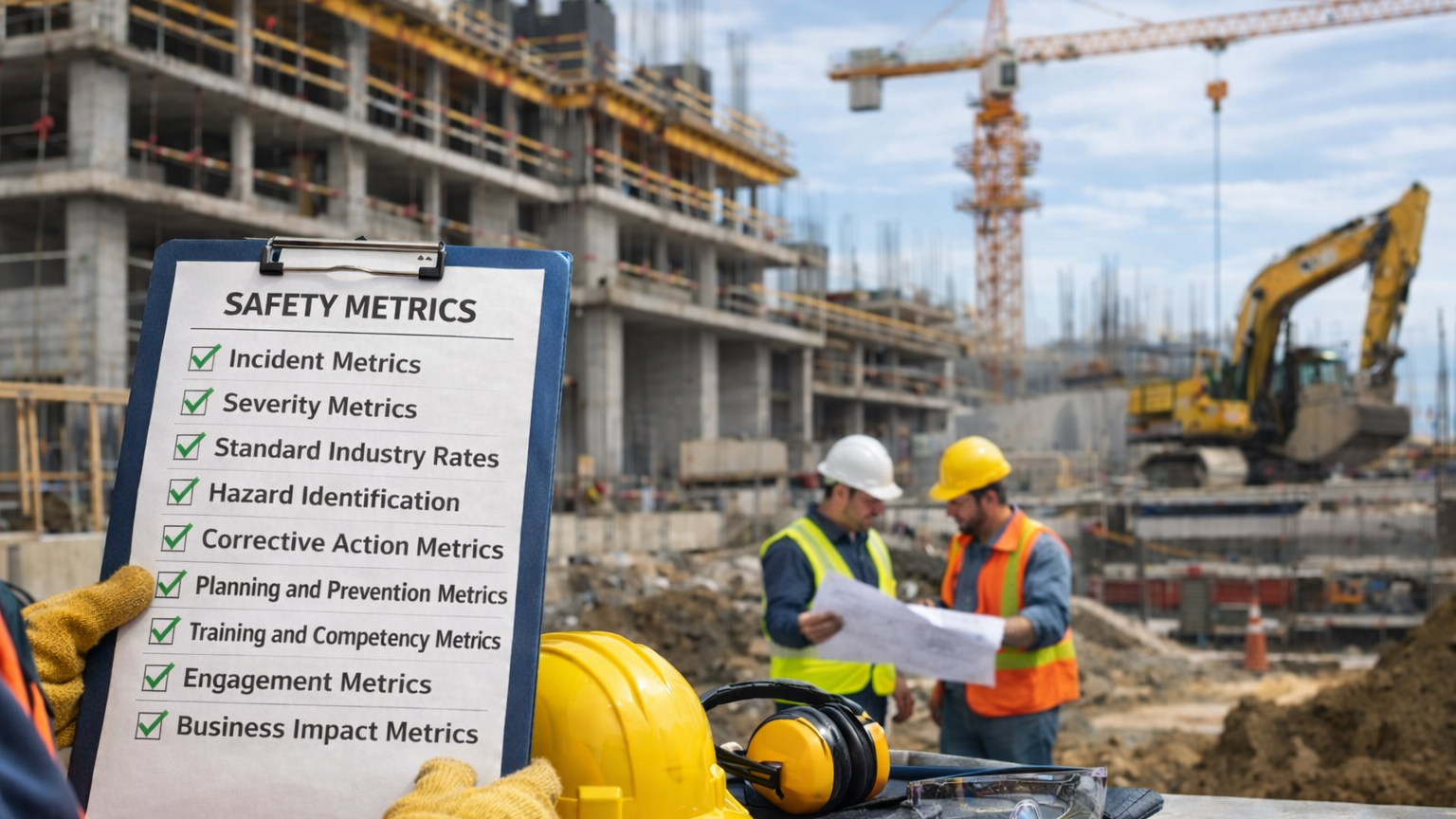
Construction safety metrics are measurable numbers that show how well a company prevents injuries, controls hazards, prepares workers, and manages risk. Some metrics look backward. Others help predict future risk. Strong companies track both.
What follows are nine categories of safety metrics and why they matter. Each section includes:
- A discussion on why and when the category matters
- A list of the relevant metrics, including how to collect and calculate their values
- Possible corrective actions to improve results
This paper helps you understand the variety of construction safety metrics in use today. There are a few core metrics every business collects, but the exact set you’ll collect is specific to your business, team, and risk exposure. Applying your knowledge of available metrics against your awareness of where risk is building is an effective guide to achieve your safety outcomes.
Construction Safety Metrics Categories
- Core Incident Metrics: What Happened
- Severity Metrics: How Serious It Was
- Standard Industry Rates: How You Compare
- Inspections and Hazard Identification: What You’re Catching
- Corrective Action Metrics: How Fast You Fix Problems
- Planning and Prevention Metrics: How Work Is Set Up
- Training and Competency Metrics: Are People Prepared
- Engagement Metrics: Are People Speaking Up
- Business Impact Metrics: What It Costs
1. Core Incident Metrics:
What Happened
Core incident metrics show what already happened on your jobsites. They’re backward-looking, but they still play a major role in future improvement. These numbers help leaders spot trends, compare crews and locations, identify repeating injury types, and uncover weak points in training, supervision, housekeeping, or hazard control.
Start with these key metrics:
- Total Incident Reports: Tracks all reported incidents, from minor events to serious injuries. A healthy number often signals strong reporting culture rather than poor performance, because workers trust the system enough to speak up.
- Total OSHA Recordable Incidents: Counts injuries and illnesses that meet OSHA recording criteria. This is one of the most watched benchmark numbers in construction and often used in prequalification reviews.
- Total Lost-Time Cases: Measures incidents where employees miss scheduled workdays. These cases often carry high medical costs, crew disruption, and schedule impact.
- Total Restricted Duty Cases: Tracks workers who return with temporary limitations or modified duties. This shows injury severity while also revealing how well your return-to-work process functions.
- Total Fatalities: The most serious metric any company can face. Even one event demands immediate response, deep review, and lasting corrective action.
- Total Near Misses: Counts incidents where no one was hurt, including high-potential events. Strong near miss reporting helps companies fix hazards before someone gets injured.
What to Do if Core Incident Metrics Are Rising
- Review incident trends by trade, location, and supervisor
- Increase field inspections on higher-risk sites
- Retrain crews on recurring injury types
- Improve new hire orientation and mentoring
- Create more accountability at the supervisor and operations level
- Speed up corrective actions after reports
- Recognize crews that actively report hazards and near misses
How often incidents happen matters, but frequency is only part of the picture. You also need to know how serious those events were.
2. Severity Metrics:
How Serious It Was
Severity metrics show how serious an incident was after it happened. They help leaders understand business impact, worker recovery time, and whether injuries are becoming more severe even when total incident counts stay low.
A company can post a low injury count and still have a serious safety problem if injuries lead to long recoveries, permanent restrictions, or major claim costs. Severity data often reveals issues that incident totals alone can hide, including weak fall protection, poor material handling practices, delayed hazard correction, or repeat exposure to the same hazard.
Start with these key metrics:
- Total Days Away from Work: Adds all lost workdays tied to recordable injuries or illnesses. This metric shows how much productivity was disrupted and how serious injuries were
- Total Restricted or Transferred Days: Adds all days employees worked under limitations or in modified roles. This helps measure injury impact while also showing return-to-work performance
- Severity Rate: Measures the seriousness of injuries based on lost time relative to hours worked. A common formula is: (Lost Days × 200,000) / Total Hours Worked
What to Do if Severity Is Rising
- Review top injury types and root causes
- Inspect high-risk tasks more often
- Strengthen pre-task planning
- Retrain supervisors on hazard recognition
- Coordinate return-to-work plans with HR and claims teams
Internal trends matter most, but outside partners often judge performance through standard benchmarks. That makes the next set of metrics hard to ignore.
3. Standard Industry Rates:
How You Compare
Standard industry rates help owners, insurers, and clients compare safety performance across companies of different sizes. These rates adjust incidents based on hours worked, which makes them more useful than raw injury counts alone.
Many pre-qualification systems, bid reviews, and insurance discussions rely on these numbers. They can influence whether you win work, what you pay for coverage, and how outside parties view your operation. They also help reveal issues that raw totals can miss, including rising claim frequency, serious cases hidden inside moderate totals, or growth that is outpacing safety systems.
Start with these key metrics:
- TRIR (Total Recordable Incident Rate): Measures OSHA recordable cases per 200,000 hours worked. This is one of the most common safety benchmarks in construction. Formula: (OSHA Recordable Cases × 200,000) / Total Hours Worked. The 200,000 factor represents 100 full-time employees working 40 hours per week for 50 weeks
- DART (Days Away, Restricted, or Transferred Rate): Measures more serious cases that involve lost time, restricted duty, or job transfer. DART often gives a clearer picture of injury severity than TRIR. Formula: (DART Cases × 200,000) / Total Hours Worked
- EMR (Experience Modification Rate): Compares your workers’ compensation claims history to what is expected for similar companies in your trade and class codes. A rating below 1.00 is often favorable. A rating above 1.00 may increase premium costs and create bid challenges. Exact calculations vary by state rating bureau and insurer.
Knowing your rates is important. Knowing how they compare is where those numbers become more useful.
OSHA and BLS Benchmark Data You Should Review
OSHA’s 2024 Work-Related Injury and Illness Summary gives employers national reference data for injury trends and reporting categories. Use it as one benchmark source when reviewing your own rates.
U.S. Bureau of Labor Statistics Injuries, Illnesses, and Fatalities Data Set offers a treasure trove of safety data that can be accessed by date ranges, statistical category, industry/trade segment (NAICS code) and company size.
Benchmark data is helpful, but outside averages should never replace internal trends. Here are some effective ways to utilize these benchmarks to assess your current situation:
- Your own last 3 years: Your trend line often tells the clearest story.
- Your trade segment: Roofing, civil, residential, utilities, and specialty trades carry different risk profiles.
- Similar company size: Small firms can see sharp swings from one incident.
What to Do if Rates Are Rising
- Review top injury causes and repeat events
- Increase inspections on higher-risk projects
- Improve supervisor accountability
- Tighten claims management and return-to-work efforts
- Strengthen training for new hires and high-risk tasks
- Track leading indicators, not just lagging results
Rates tell others how you compare. Prevention starts earlier, with what your team sees and reports before anyone gets hurt.
4. Inspections and Hazard Identification:
What You’re Catching
Inspection and hazard identification metrics show what your company is catching before someone gets hurt. These are strong leading indicators because they measure prevention activity, field visibility, and how willing crews are to speak up.
Companies that find hazards early usually prevent injuries later. These metrics can also reveal weak supervision, recurring housekeeping issues, poor subcontractor controls, or reporting systems that workers don’t trust.
Start with these key metrics:
- Total Inspections Completed: Tracks the number of scheduled or unscheduled inspections completed across jobsites, yards, shops, and fleet operations. This confirms field presence and shows whether leaders are actively checking conditions.
- Total Hazards Identified: Counts unsafe conditions, unsafe acts, or exposure risks found during inspections, observations, or employee reports. A healthy number often reflects active detection, not poor performance.
What to Do if These Metrics Are Weak
- Set inspection frequency targets by project size
- Train supervisors on hazard recognition
- Make reporting fast and simple through mobile tools
- Review trends by site, trade, and supervisor
- Audit inspection quality, not just inspection quantity
Finding hazards is a strong start, but open hazards still create risk. What matters next is how fast those issues get fixed.
Improving Metrics with HB NEXT’s Sequence XT and Compliance Partner Program (CPP)
Most contractors don’t struggle with knowing which safety metrics matter. They struggle with collecting accurate data, keeping records current, following up on open items, and turning reports into real field action across multiple active jobsites.
That is where HB NEXT delivers real value.
HB NEXT helps construction companies strengthen safety performance with Sequence XT, a purpose-built construction safety platform designed to simplify safety management and improve visibility across the business. Many opt for HB NEXT’s Compliance Partner Program, which integrates onsite safety staffing, expert consulting, and managed compliance services to ease the burden of administering your safety program.
With HB NEXT and Sequence XT, your team can:
- Track key safety metrics in one place: Includes inspections, incidents, corrective actions, training status, and compliance records.
- Speed up corrective action closure: Uses clear ownership, due dates, reminders, and real-time status updates.
- Improve training completion and readiness: Supports role-based training records, orientation tracking, and credential expiration alerts.
- Increase field visibility across jobsites: Uses mobile inspections, audits, and dashboards that highlight emerging risk.
- Reduce administrative burden: Replaces spreadsheets, scattered files, and manual follow-up with one organized system.
- Strengthen OSHA, DOT, and environmental compliance: Provides expert guidance and managed support.
- Keep documentation audit-ready: Organizes records for client reviews, audits, and inspections.
- Support growth without adding overhead: Extends your internal team with outsourced compliance expertise.
The result is more than cleaner data. It is faster decisions, better accountability, stronger training control, and safer operations in the field. For companies managing several crews or dozens of sites, that can mean fewer repeat issues, steadier incident reduction, stronger pre-qualification performance, and tighter operational control.
5. Corrective Action Metrics:
How Fast You Fix Problems
Finding hazards matters. Fixing them fast matters even more. Corrective action metrics show whether your company fixes problems quickly, completely, and in a way that prevents repeat issues.
Many companies are good at finding hazards. Fewer are good at closing them with urgency and accountability. These metrics often reveal slow field response, weak ownership, poor follow-up, or temporary fixes that never solve the real problem.
Start with these key metrics:
- Total Corrective Actions Closed: Tracks the number of assigned corrective actions completed during a set period. This shows work completed and overall follow-through.
- Corrective Action Closure Rate: Measures how many actions were closed compared with how many were opened. Formula: Closed Corrective Actions ÷ Opened Corrective Actions. A low closure rate can mean backlog, weak ownership, or unrealistic timelines.
- Total Overdue Corrective Actions: Counts actions that passed the due date without completion. This shows risk left in place and unresolved exposure.
- Average Time to Close: Measures the average number of days it takes to complete corrective actions. This reflects speed of response and operational discipline.
- Repeat Findings: Tracks hazards that return after they were marked complete. This is one of the clearest signs of weak fixes, poor verification, or lack of accountability.
What to Do if Corrective Action Metrics Are Weak
- Assign one clear owner for every action
- Use realistic due dates based on risk level
- Escalate overdue high-risk items quickly
- Verify fixes in the field before closing them
- Review repeat findings monthly
- Track closure performance by supervisor and project
- Add positive items to your scoring metrics to drive better employee engagement
- Use mobile tools to speed updates and visibility
Fast fixes help, but the strongest results come from preventing issues before work begins. That starts with planning the job the right way.
6. Planning and Prevention Metrics:
How Work Is Set Up
Planning and prevention metrics show how well work is set up before tools start moving and crews begin tasks. Strong planning reduces surprises, controls changing risks, and helps crews work safer from the first minute of the shift.
Many serious incidents begin long before the incident itself. They start with rushed planning, vague expectations, weak communication, or missed hazards. These metrics help reveal whether crews are truly preparing for the work ahead or simply completing forms.
Start with these key metrics:
- Total Job Hazard Analyses (JHAs) Completed: Tracks how many Job Hazard Analyses, Activity Hazard Analyses, or pre-task plans were completed before work began. This helps confirm planning is happening consistently.
- Total Pre-Task Plans Completed: Measures how often crews pause to review the day’s scope, hazards, controls, tools, and responsibilities. This is especially useful for short-duration or changing work.
What to Do if Planning Metrics Are Weak
- Require task-specific JHAs for changing work
- Audit quality, not just completion counts
- Train foremen to lead useful pre-task talks
- Use mobile tools to update plans in real time
- Add approvals for high-risk work scopes
- Review incidents to see where planning failed
- Recognize crews that improve planning quality
Even the best plan depends on people who know how to carry it out. That is why readiness and competency come next.
7. Training and Competency Metrics:
Are People Prepared
Training counts, but readiness matters more. Training and competency metrics show whether workers, supervisors, and leaders are actually prepared to perform their jobs safely and correctly.
Many companies track classes completed. Stronger companies track whether the right people have the right skills at the right time. These metrics often reveal weak onboarding, expired credentials, poor field coverage, or growth that has outpaced safety support.
Start with these key metrics:
- Training Completion Rate: Measures how many employees completed required training. The better way to measure it is by role, not by total headcount. Ask: Have all foremen completed supervisor training? Have equipment operators completed operator requirements? Have laborers completed required site basics?
- New Hire Orientation Completion: Tracks whether employees complete orientation before jobsite access. This is one of the most important early controls for preventing first-month injuries.
- Credentialed Training Status: Tracks certifications, licenses, and required credentials with active expiration date management. Examples include forklift operators, crane signal persons, competent persons, CDL drivers, and trade-specific credentials.
- Ratio of Trained Competent Persons to Active Jobsites: Measures whether qualified leaders are available where work is happening. This helps show real field coverage, not just training history.
- Ratio of Full-Time Safety Staff vs Worker Count: Measures whether your safety team is large enough to support the size and complexity of your workforce. As headcount, jobsites, or project risk increase, safety staffing often needs to grow as well. If it does not, inspections, training, follow-up, and field support can suffer.
What to Do if Training Metrics Are Weak
- Track training by role and responsibility
- Require orientation before site access
- Match toolbox talk topics to current tasks and seasonality
- Use automated alerts for expiring credentials
- Review competent person coverage weekly
- Increase safety staffing during rapid growth
- Test field understanding, not just attendance
Training gives people the tools, but culture determines whether they use them and speak up when something is wrong. That is where engagement metrics matter.
8. Engagement Metrics:
Are People Speaking Up
Engagement metrics show whether employees feel safe enough to speak up, share concerns, and help improve the workplace. When workers participate, leaders gain earlier warning signs and better visibility into jobsite risk.
Silence is rarely a sign of safety. More often, silence means people don’t believe reporting will help. These metrics often reveal fear of blame, weak supervisor response, slow follow-up, or missed opportunities to learn from frontline workers.
Start with these key metrics:
- Near Miss Reporting Participation: Tracks how often employees report incidents where no one was hurt, but harm could have happened. Strong participation helps uncover serious risks before injuries occur.
- Hazard Reporting Participation: Measures how often workers report unsafe conditions, damaged equipment, blocked access, missing guards, poor housekeeping, or other hazards.
- Safety Observation Participation: Tracks employee involvement in sharing safe behaviors, unsafe acts, and field observations. This can help reinforce positive habits while identifying gaps.
- Improvement Idea Participation: Measures how often workers suggest smarter, safer ways to perform tasks, improve tools, reduce strain, or solve recurring issues.
What to Do if Engagement Metrics Are Weak
- Make reporting simple through mobile tools or QR codes
- Allow anonymous reporting where appropriate
- Thank employees who raise concerns
- Close reported issues quickly and visibly
- Share wins created by worker feedback
- Train supervisors to respond professionally
- Track participation by project, shift, and crew
When workers speak up, risk becomes easier to control. It also becomes easier to see what safety performance is costing the business.
9. Business Impact Metrics:
What It Costs
Executives need cost metrics tied to safety performance. Business impact metrics show how injuries, claims, citations, and damage affect profit, cash flow, schedules, and growth.
When leaders understand the financial side of safety, improvement efforts gain traction faster. These metrics often reveal losses hidden behind low incident counts, including expensive claims, fleet damage, repeat citations, downtime, and preventable operational disruption.
Start with these key metrics:
- Average Workers’ Compensation Claim Cost: Measures the average cost per claim, including medical payments, indemnity costs, and related expenses. This helps identify severity trends. A small drop in claim count with a sharp rise in average cost may signal more serious injuries.
- OSHA Citations Issued: Tracks citations received after inspections or investigations. This helps measure regulatory exposure and can reveal recurring compliance gaps.
- Total Fines Incurred: Measures direct financial penalties tied to OSHA or other enforcement actions. Fines are visible losses that often come with added indirect costs.
- Property, Equipment, and Vehicle Damage Costs: Tracks repair, replacement, rental, towing, downtime, and related loss tied to unsafe operation or preventable incidents. These costs are often underreported, yet they can be substantial.
Direct losses are only part of the picture. Many companies also need a way to estimate the broader financial impact of injuries and incidents.
Use OSHA Safety Pays for ROI Discussions
OSHA’s Safety Pays estimator helps employers estimate direct and indirect injury costs. It can be a useful tool when presenting the return on investment for training, equipment upgrades, staffing, or prevention programs.
Many injury costs never appear on the in the initial claim amount. Lost productivity, overtime, retraining, delays, and management time often exceed direct medical or claim costs.
What to Do if Business Impact Metrics Are Rising
- Review top claim causes and repeat injury types
- Improve return-to-work coordination
- Increase driver and equipment operator training
- Fix citation trends before repeat enforcement occurs
- Analyze downtime tied to damaged assets
- Invest in controls where losses are highest
- Present monthly cost trends to leadership
American Society of Safety Professionals (ASSP) research shows a direct positive correlation between investment in safety and its subsequent ROI. The return is often cited as $4 to $6 for every $1 spent on safety.
Once the financial impact is clear, most companies ask the same question, how do we manage all of this without adding more burden to the team?
Improve Metrics AND Outcomes
Ready to improve your safety metrics and reduce the workload on your team? HB NEXT can help by reviewing your current safety manual, automating your safety processes with Sequence XT construction safety software, or hiring our professionals to work alongside your team to improve specific metrics. We also deliver more than 100 safety training classes across public, private, virtual and on-demand channels. Schedule a free consultation to get started.